Tags
bradshaw, brady, giants, manning, manningham, new england, new york, nfl, nicks, patriots, playoffs, super bowl
I am not second guessing. I was first guessing.
On the New York Giants’ final offensive possession of Super Bowl XLVI, the New England Patriots should have let the Giants reach the end zone before they eventually did. Yes, let them score.
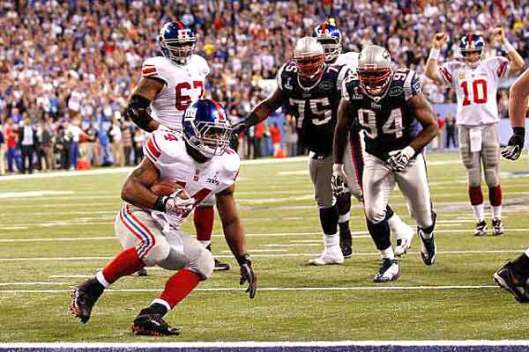
Ahmad Bradshaw tries to not score a touchdown...unsuccessfully
With the score Giants 15, Patriots 17, the Patriots punted to New York’s 12-yard line with 3:46 remaining in the fourth quarter. The first play of the drive turned out to be the play of the game as Eli Manning and Mario Manningham connected for a 38-yard pass completion down the near sideline bringing the ball to midfield. Manningham clearly caught the ball in-bounds but I don’t fault the Patriots for challenging the play for a few reasons.
- It was the biggest play of the game and put the ball all the way at midfield.
- The play was close enough (in real-time) to challenge.
- New England didn’t have much time to decide to challenge because New York was rushing to the line to snap the next play. The Giants weren’t so sure themselves.
The failed challenge cost the Patriots their first timeout of the second half. So, with a 1st and 10 and the ball at midfield with 3:39 Eli Manning proceeded to look Manningham’s way three more times in a row resulting in an incompletion, and receptions of 16 and two yards. This put the ball at New England’s 32-yard line, 2nd and 8 with 2:09 remaining. New York had one timeout; New England still had two.
If I’m New England in this situation I am extremely nervous. Over two minutes remaining, the Giants are in field goal range, and a made field goal leaves you chasing a point. I’m hoping my defense can hold New York, but in this situation I’m not exactly optimistic. Still, you have to see if your defense can do its job and force a 45+ yard field goal attempt.
The next play was a 14-yard completion to New England’s 18-yard line, Manning to Hakeem Nicks which also brought the game to the two-minute warning. At the two-minute warning New York has a 1st and 10 in the red zone and unless they go backwards, a 35-yard field goal attempt. Giants’ kicker Lawrence Tynes, for his career, is over 78% from 30-39 yards and the game was being played indoors. Watching the game I put myself in New England’s shoes and thought, I might be able to live with a 35-yard field goal attempt but I would seriously consider letting New York score a touchdown even from 18 yards out. If New York got any closer, I would definitely let them score. New England hadn’t stopped New York at all on the drive; five plays, four completions for 70 yards. The game was at the two-minute warning. There was additional time for New England to think about and plan for the final two minutes.
Following the first play after the two-minute warning, the Patriots’ strategy should have become crystal clear. The play, a 7-yard run by Ahmad Bradshaw, put the ball on New England’s 11-yard line. You must let New York score a touchdown on the next play. That’s really the only option that gives you a realistic chance of winning (as long as New York doesn’t give you a chance – more on this later).
Following the play here is the situation. 2nd and 3, at New England’s 11-yard line, the Patriots have 2 timeouts, and about 1:50 or so remaining. A field goal attempt from the 11-yard line is about 28 yards. If you’re New England, unless you push New York’s offense back considerably you are hoping Tynes pulls a Billy Cundiff. Unlikely. At this point here were New England’s options:
- Leave your defense out on the field and hopefully they pull off something miraculous ((multiple) negative plays, a takeaway, or a blocked field goal). Again, they had not stopped New York at all on the drive.
- Take a timeout after the play with approximately 1:50 left. Hopefully you stop the Giants on 2nd and 3. You take your last timeout with, say, 1:45 remaining and a 3rd and short upcoming. You stop New York on 3rd down. The Giants bleed the clock down just under a minute and kick the go-ahead field goal from 26-28 yards. You’re banking on a defense that couldn’t stop New York at all on the possession, but if they were successful would give the Patriots the ball down only one point with a little under a minute left, no timeouts.
- Call a timeout with about 1:50 left, leaving your team with one. On the next play you let New York score a touchdown which at that point I suspect they would have taken (the next play was a PASS to Nicks). You would hand the ball over to Tom Brady and the offense with let’s say 1:40 remaining with a timeout down by either four or six points depending on the two-point conversion(*).
*Let’s say New York doesn’t take the touchdown and purposefully falls down at the one-yard line. You let a 28-yard field goal become an 18-yard field goal. The difference between a 28 and 18 yard field goal is not all that much in my opinion. You have to gamble and hopefully New York will take the touchdown.
I like option three. I’d rather put the ball in Brady’s hands with over 1:30 remaining and a timeout needing a touchdown than hope my defense holds the Giants on the 11-yard line as you cling to a one-point lead. This isn’t the first time a situation like this has taken place in a football game, obviously. Whenever I see a situation similar I am almost always a proponent of letting the opponent score a touchdown which would allow the offense a chance to win the game. I very rarely see teams implement this strategy though. As was the case here when the team finally does let the other score, it’s too late.
Back to the game. After Bradshaw’s run the Patriots did not call a timeout. Why? I do not know. New York bled the clock down to 1:15 before snapping the next play, a four-yard completion Manning to Nicks. Why did the Patriots not give up the touchdown to Nicks? I do not know. Nicks was pushed out of bounds on the play stopping the clock. It’s now 1st and goal from the 7-yard line with 1:09 left. Again, LET THEM SCORE! Instead, Bradshaw ran the ball for one-yard to the six. New England finally took its second timeout after the play with 1:04 remaining. In each play previous it looked like the Giants would have taken a touchdown (but who knows). Either way, if you’re New England you’re in a really bad spot. Anyway, the play out of that timeout was one of the most memorable of the game as Ahmad Bradshaw ran up the middle, seemed to attempt to stop himself prior to reaching the end zone before his momentum carried him in for the go-ahead touchdown and a 21-17 Giants lead with :57 remaining. Switching sides here, if I’m the Giants I do everything I can to not give the ball back to the Patriots with any time left (OK, maybe 20 seconds or so is safe enough). The best option for New York, obviously, would have been to run the clock down and kick a game winning field goal (or a very late touchdown) with a few seconds left. Bradshaw did try to stop at least. It finally looked like on that play New England was letting New York score. The Patriots, in my opinion, were at least two plays too late and let 45 seconds or so run off the clock. Instead of approximately 1:40, a timeout and the ball in Brady’s hands, the Patriots had only 57 seconds when they received the ball needing a touchdown. If the Giants would have executed what they wanted to do, the Patriots would have either gotten the ball back with less time or wouldn’t have gotten the ball back at all. Following a touchback New England got the ball at their 20-yard line. They were able to muster 29 yards bringing the ball to their own 49 yard-line and were forced to take their final timeout in the process. That left Tom Brady with one heave into the end zone for a potential game winning touchdown with no time remaining. Alas.
Who knows what would have happened if the Patriots’ offense had another 45 seconds to work with.
Bullet Points:
- There were 9 total penalties in the game and a couple were extremely costly to New England.
- First, Tom Brady’s intentional grounding penalty on New England’s first offensive play – this also destroyed New England’s time of possession for the entire game (The Patriots took their next (2nd) offensive snap with 3:18 remaining in the 1st quarter)
- New England’s 12 men on the field penalty on Victor Cruz’s fumble which was recovered by the Patriots – two plays later the Giants scored the first touchdown in the game
- The drop by Wes Welker in the Patriots’ second-to-last drive was tough but Brady didn’t exactly put the ball on his numbers. If Welker catches the pass New England probably wins the game and all the storylines today are much different.
 Wedge Hammer
Pingback: In Review: February 2012 « Wedge Hammer